
TRIO-PS-2G/230AC-400DC/48DC/5
Product ID:22075
Updated: 2026/10/9
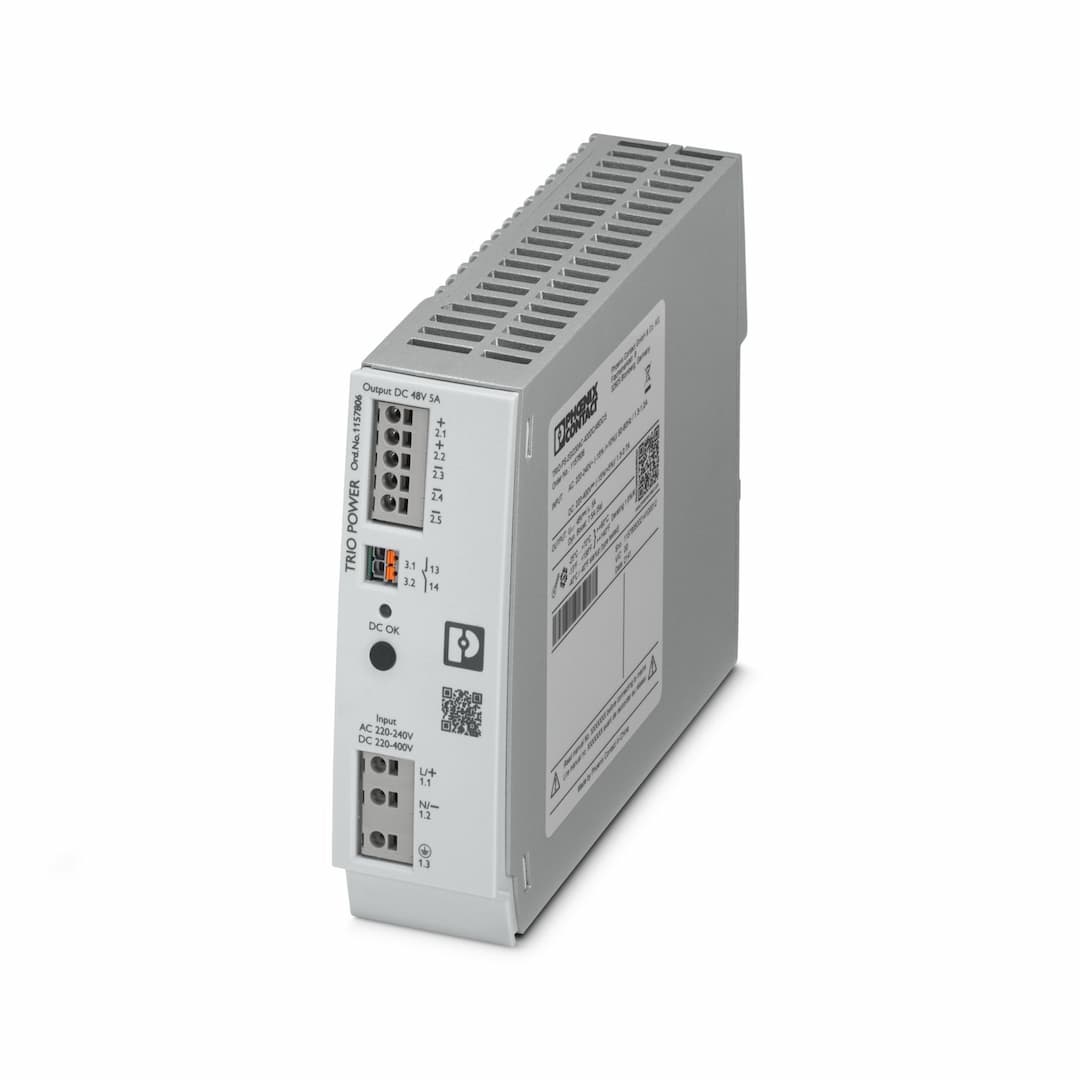
Key Features
- 1Primary-switched design for reliable operation.
- 2Tool-free fast-connection technology for easy installation.
- 3Dynamic boost of up to 150% for 5 seconds to handle demanding loads.
- 4Compact DIN rail mounting for space-saving installations.
- 5Wide input voltage range (230 V AC/400 V DC) for versatile applications.
Need a quote? Enter your quantity and get pricing fast.
Qty
Technical Specifications
Detailed engineering parameters
| Parameter | Value | Parameter | Value |
|---|---|---|---|
| Supply system configuration | Star network (TN, TT, IT (PE)) | Nominal input voltage range | 220 V AC ... 240 V AC |
| Input voltage range | 220 V AC ... 240 V AC -15 % ... +10 % | Switch-on voltage | typ. 70 V AC |
| Shut-down voltage | typ. 50 V AC | Electric strength, max. | ≤ 300 V AC 15 s |
| Typical national grid voltage | 230 V AC | Voltage type of supply voltage | AC |
| Inrush current integral (I | < 0.3 A | Inrush current limitation | < 13.5 A (after 1 ms) |
| AC frequency range | 50 Hz ... 60 Hz ±10 % | Mains buffering time | > 20 ms (190 V AC)
> 20 ms (230 V AC) |
| Current consumption | 1.3 A (230 V AC) | Nominal power consumption | 285.7 VA |
| Power factor (cos phi) | 0.91 | Input fuse | 3.15 A (internal (device protection)) |
| Recommended breaker for input protection | 4 A ... 16 A (Characteristic B, C, Z) | Discharge current to PE | < 3.5 mA
< 1.7 mA (264 V AC, 60 Hz) |
| POWER factor | > 0.9 (230 V AC) | Nominal input voltage range | 220 V DC ... 400 V DC |
| Input voltage range | 220 V DC ... 400 V DC -15 % ... +5 % | Derating | < 99 V DC (2 %/V) |
| Switch-on voltage | typ. 95 V DC | Shut-down voltage | typ. 50 V DC |
| Electric strength, max. | ≤ 420 V DC | Voltage type of supply voltage | DC |
| Mains buffering time | > 20 ms (185 V DC)
> 25 ms (400 V DC) | Current consumption | 1.3 A (220 V DC)
0.7 A (400 V DC) |
| Efficiency | typ. 92.5 % (230 V AC)
typ. 94 % (400 V DC) | Output characteristic | U/I with dynamic load reserve |
| Nominal output voltage | 48.5 V DC ±1 % | Nominal output current (I | 5 A |
| Dynamic Boost (I | 7.5 A (5 s) | Derating | > 60 °C ... 70 °C (2.5 %/K) |
| POWER factor | > 0.9 (120 V AC)
> 0.9 (230 V AC) | Feedback voltage resistance | ≤ 60 V DC |
| Protection against overvoltage at the output (OVP) | ≤ 58 V DC | Control deviation | < 1.5 % (change in load, static 10 % ... 90 %)
< 4 % (Dynamic load change 10 % ... 90 %, 10 Hz)
< 0.1 % (change in input voltage ±10 %) |
| Residual ripple | < 20 mV | Short-circuit-proof | yes |
| No-load proof | yes | Output power | 240 W
360 W |
| Peak switching voltages nominal load | < 15 mV | Maximum no-load power dissipation | typ. 4 W (230 V AC)
typ. 4 W (400 V DC) |
| Power loss nominal load max. | typ. 20 W (230 V AC)
typ. 15 W (400 V DC) | Short-circuit current | < 7 A DC (Permanent) |
| Rise time | 20 ms (U | Connection in parallel | yes, for redundancy and increased capacity |
| Continuous load current | 100 mA | Default | closed |
| Digital | 30 V AC 30 V DC 100 mA | Connection method | Push-in connection |
| Conductor cross section, rigid min. | 0.2 mm² | Conductor cross section, rigid max. | 4 mm² |
| Conductor cross section flexible min. | 0.2 mm² | Conductor cross section flexible max. | 2.5 mm² |
| Single conductor/flexible terminal point with ferrule with plastic sleeve, min. | 0.25 mm² | Single conductor/flexible terminal point with ferrule with plastic sleeve, max. | 1.5 mm² |
| Single conductor/flexible terminal point with ferrule without plastic sleeve, min. | 0.25 mm² | Single conductor/flexible terminal point with ferrule without plastic sleeve, max. | 2.5 mm² |
| Conductor cross section AWG min. | 24 | Conductor cross section AWG max. | 12 |
| Connection method | Push-in connection | Conductor cross section, rigid min. | 0.2 mm² |
| Conductor cross section, rigid max. | 4 mm² | Conductor cross section flexible min. | 0.2 mm² |
| Conductor cross section flexible max. | 2.5 mm² | Single conductor/flexible terminal point with ferrule with plastic sleeve, min. | 0.25 mm² |
| Single conductor/flexible terminal point with ferrule with plastic sleeve, max. | 1.5 mm² | Single conductor/flexible terminal point with ferrule without plastic sleeve, min. | 0.25 mm² |
| Single conductor/flexible terminal point with ferrule without plastic sleeve, max. | 2.5 mm² | Conductor cross section AWG min. | 24 |
| Conductor cross section AWG max. | 12 | Connection method | Push-in connection |
| Conductor cross section, rigid min. | 0.2 mm² | Conductor cross section, rigid max. | 0.75 mm² |
| Conductor cross section flexible min. | 0.2 mm² | Conductor cross section flexible max. | 1.5 mm² |
| Single conductor/flexible terminal point with ferrule with plastic sleeve, min. | 0.2 mm² | Single conductor/flexible terminal point with ferrule with plastic sleeve, max. | 0.75 mm² |
| Single conductor/flexible terminal point with ferrule without plastic sleeve, min. | 0.2 mm² | Single conductor/flexible terminal point with ferrule without plastic sleeve, max. | 1 mm² |
| Conductor cross section AWG min. | 24 | Conductor cross section AWG max. | 18 |
| Types of signaling | Floating signal contact | Signalization designation | DC OK |
| Status display | LED | Color | green |
| DC OK | U | Number of phases | 1.00 |
| Insulation voltage input/output | 3.5 kV AC (type test)
1.5 kV AC (routine test) | Product type | Power supply |
| Product family | TRIO POWER | MTBF (IEC 61709, SN 29500) | > 2220000 h (25 °C)
> 1280000 h (40 °C)
> 560000 h (60 °C)
> 2220000 h (25 °C)
> 1280000 h (40 °C)
> 560000 h (60 °C) |
| Article revision | 02 | Protection class | I (in closed control cabinet) |
| Degree of pollution | 2 | Width | 42 mm |
| Height | 130 mm | Depth | 160 mm |
| Installation distance right/left | 0 mm / 0 mm | Installation distance top/bottom | 50 mm / 50 mm |
| Mounting type | DIN rail mounting | Assembly note | alignable: horizontally 0 mm (≤ 40 °C) 10 mm (≤ 70 °C), vertically 50 mm |
| Mounting position | horizontal DIN rail NS 35, EN 60715 | With protective coating | no |
| Flammability rating according to UL 94 (housing / terminal blocks) | V0 | Housing material | Metal |
| Type of housing | Aluminum (AlMg3) | Hood version | Polycarbonate |
| Degree of protection | IP20 | Ambient temperature (operation) | -25 °C ... 70 °C (>60°C derating: 1.6%/K) |
| Ambient temperature (storage/transport) | -40 °C ... 85 °C | Ambient temperature (start-up type tested) | -40 °C |
| Maximum altitude | ≤ 2000 m | Climatic class | 3K3 (EN 60721) |
| Max. permissible relative humidity (operation) | ≤ 95 % (at 25 °C, non-condensing) | Shock | 20 m/s² (2g), 11 ms, ± 100 Schocks (DIN EN 50125-3, DIN EN 60068-2-27) |
| Vibration (operation) | 5 Hz ... 2 kHz, 2.3 m/s² (0.23g) (RMS) 5 h (DIN EN 50125-3, DIN EN 60068-2-64) | Rail applications | EN 50121-3-2
EN 50121-4
EN 50124-1
EN 50125-3
IEC 62236-3-2
IEC 62236-4
IEC 62236-5 |
| Standard – Limitation of mains harmonic currents | EN 61000-3-2 | Standard - Electrical safety | EN 61010-1
VDE 0805 (SELV) |
| Standard – Safety extra-low voltage | IEC 61010-1 (SELV)
IEC 61010-2-201 (PELV) | Standard - Safe isolation | IEC 61010-2-201
IEC 61558-2-16 |
| Standard - Safety of power supply units up to 1100 V (insulation distances) | DIN EN 61558-2-16 | EN 62477-1 | II (≤ 2000 m)
III (≤ 2000 m) |
| UL approvals | UL 61010-1
UL 61010-2-201 | SIL in accordance with IEC 61508 | 0 |
| Electromagnetic compatibility | Conformance with EMC Directive 2014/30/EU | Low Voltage Directive | Conformance with Low Voltage Directive 2014/35/EC |
| Interference emission | Interference emission in accordance with EN 61000-6-3 (residential and commercial) and EN 61000-6-4 (industrial) | EMC requirements for noise immunity | EN 61000-6-1
EN 61000-6-2 |
| Conducted noise emission | EN 55016
EN 61000-6-3 (Class B) | Noise emission | EN 55011 (EN 55022) |
| Noise emission | EN 55016
EN 61000-6-3 (Class B) | Standards/regulations | EN 61000-3-2 |
| Frequency range | Class A | Standards/regulations | EN 61000-3-3 |
| Frequency range | 0 kHz ... 2 kHz | Standards/regulations | EN 61000-4-2 |
| Contact discharge | 6 kV (Test Level 4) | Discharge in air | 8 kV (Test Level 4) |
| Comments | Criterion A | Standards/regulations | EN 61000-4-3 |
| Frequency range | 80 MHz ... 1 GHz | Test field strength | 20 V/m (Test Level 3) |
| Frequency range | 1 GHz ... 2 GHz | Test field strength | 10 V/m (Test Level X) |
| Frequency range | 2 GHz ... 2.7 GHz | Test field strength | 10 V/m (Test Level 3) |
| Comments | Criterion A | Standards/regulations | EN 61000-4-4 |
| Input | 4 kV (Test Level 4 - asymmetrical) | Output | 2 kV (Test Level 3 - asymmetrical) |
| Signal | 2 kV (Test Level 4 - asymmetrical) | Comments | Criterion A |
| Standards/regulations | EN 61000-4-5 | Input | 1 kV (Test Level 1 - symmetrical)
2 kV (Test Level 1 - asymmetrical) |
| Output | 0.5 kV (Test Level 1 - symmetrical)
0.5 kV (Test Level 1 - asymmetrical) | Signal | 0.5 kV (Test Level 2 - asymmetrical) |
| Comments | Criterion B | Standards/regulations | EN 61000-4-6 |
| I/O/S | asymmetrical | Frequency range | 0.15 MHz ... 80 MHz |
| Comments | Criterion A | Voltage | 10 V (Test Level 3) |
| Standards/regulations | EN 61000-4-11 | Voltage | 230 V AC |
| Frequency | 50 Hz | Voltage dip | 70 % |
| Number of periods | 25 periods | Additional text | Test Level 2 |
| Comments | Criterion A | Voltage dip | 40 % |
| Number of periods | 10 periods | Additional text | Test Level 2 |
| Comments | Criterion A | Voltage dip | 0 % |
| Number of periods | 1 period | Additional text | Test Level 2 |
| Comments | Criterion A | Standards/regulations | EN 61000-6-3 |
| Radio interference voltage in acc. with EN 55011 | EN 55011 (EN 55022) Class B, area of application: Industry and residential | Emitted radio interference in acc. with EN 55011 | EN 55011 (EN 55022) Class B, area of application: Industry and residential |
| Criterion A | Normal operating behavior within the specified limits. | Criterion B | Temporary impairment to operational behavior that is corrected by the device itself. |
| Criterion C | Temporary adverse effects on the operating behavior, which the device corrects automatically or which can be restored by actuating the operating elements. |
Specifications may be subject to change without notice
Still deciding on TRIO-PS-2G/230AC-400DC/48DC/5?
Our engineers can confirm stock, price, and lead time for this Phoenix Contact part.
Get a no-obligation quote in 1 minute.